Learn HTML
HTML (Hypertext Markup Language) is a standard markup
language used for creating and structuring the content on the
web. Over the years, HTML has evolved, and the latest version
is HTML5. HTML5 introduced several new features and
enhancements to improve the development of web pages and
applications

Menu
HTML HOME
HTML stands for “Hypertext Markup Language.” It is the standard markup language used to create and design the structure of web pages. HTML consists of a series of elements, each represented by tags, that define the different parts of a document.These elements can include headings, paragraphs, lists, links, images, forms, tables,and more
Here’s a basic breakdown of how HTML works:
1. Tags: HTML documents are made up of HTML tags. Tags are used to define elements on a webpage. They are enclosed in angle brackets like . Tags usually come in pairs: an opening tag and a closing tag, with the content between them.
HTML
<p>This is a paragraph.</p>
2.Attributes: HTML tags can also have attributes, which provide additional information about an element. Attributes are added to the opening tag and are usually in name/value pairs.
HTML
<A HREF=”HTTP://WWW.EXAMPLE.COM”>Visit Example.com </A>
3.Document Structure: An HTML document typically includes a declaration (<!DOCTYPE html>), an opening and closing <html> tag, <head> and <body>sections, and various other elements within these sections.
HTML
<!DOCTYPE html>
<html>
<body>
<h1>My First Heading</h1>
<p>My first paragraph.</p>
</body>
</html>
4.Elements: Elements are the building blocks of HTML. They define the structure and content of a webpage. Examples of elements include headings (<h1>,<h2>).Paragraph(<p>), lists(<ul>,<ol>,<li>) links(<A>),image(<img>)And more.
Features of HTML
1.Semantic Elements: HTML5 introduced semantic elements like <header>, <nav>, <article>, <section>, <footer>, etc. These elements provide a more meaningful and structured way to describe the content of a web page, improving accessibility and search engine optimization.
2.Audio and Video Support: HTML5 provides native support for embedding audio and video content using the <audio> and <video> elements. This eliminates the need for third-party plugins, offering a standardized and more efficient way to include multimedia content on web pages
3.Form Enhancements: HTML5 introduced new form input types and attributes, such as <input type=”date”>, <input type=”email”>, <input type=”url”>, <input type=”number”>, and the required attribute. These additions simplify capturing specific types of user input and enable client-side validation.
4.Canvas Element: The <canvas> element allows developers to draw graphics, create animations, and manipulate images directly in the browser. It provides a powerful and flexible way to create dynamic visual content without relying on external plugins.
5.Local Storage: HTML5 introduced the localStorage API, enabling web applications to store key-value pairs locally on the user’s device. This feature allows for persistent data storage between sessions, improving performance and user experience.
6.Responsive Design Features: HTML5 includes features that support responsive web design. The <picture> element, for instance, allows developers to provide multiple image sources based on screen size or resolution, contributing to the creation of web pages that adapt seamlessly to different devices.
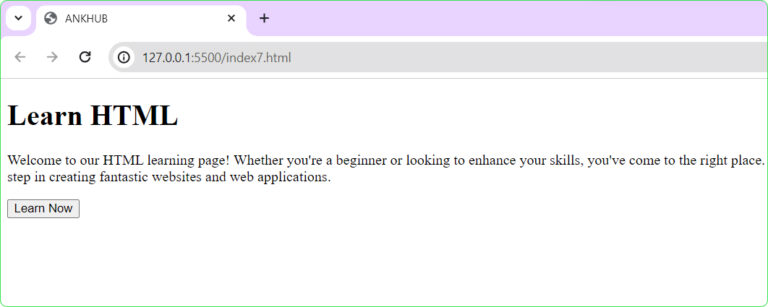
Browser Output